Re-referencing
BMRB shifts are sometimes mis-referenced — a constant offset shifts every peak of
a given nucleus. ChemicalShifts.reref corrects this in
place using one of two published methods.
Usage
import makeshift as ms

cs = ms.ChemicalShifts.from_bmrb(4527)
cs.reref(method="panav")     # or "lacs"
print(cs.reref_offsets)      # {'N': ..., 'CA': ..., 'CB': ..., ...}
print(cs.reref_cona)         # CONA fragment-scan summary (PANAV only)
Or apply it on load:
reref_offsets holds the offset applied to each nucleus
(corrected = Val + offset, paper convention offset ≈ d_ave − d_obs),
so the correction is fully transparent and reversible.
The two methods
PANAV
PANAV (Wang & Wishart 2005;
Wang, Wang & Wishart 2010)
assigns secondary structure from HA (PSSI joint probabilities + a short
density smooth), fits N/CA/CB/C′ offsets as
<Δδ> = mean(d_ave − d_obs), then refreshes SS twice with trial-adjusted
C/N. Deviant atoms (6σ) are excluded. Afterward CONA scores contiguous
3–6 residue windows (cs.reref_cona).
LACS
LACS (Wang et al. 2005; Wang & Markley 2009) fits secondary shift vs. CSI (CA−CB) so the random-coil regime intercepts at the origin; it covers CA, CB, C′, N, and HN. Coil baselines include nearest-neighbor corrections from official LACS (BMRB / Liya Wang): Wishart Table 5 pre-Pro for CA/CB/C′, and Wishart Table 8 i−1 correction for N. The N/H fit excludes GLY/CYS/PRO on residue i−1 .
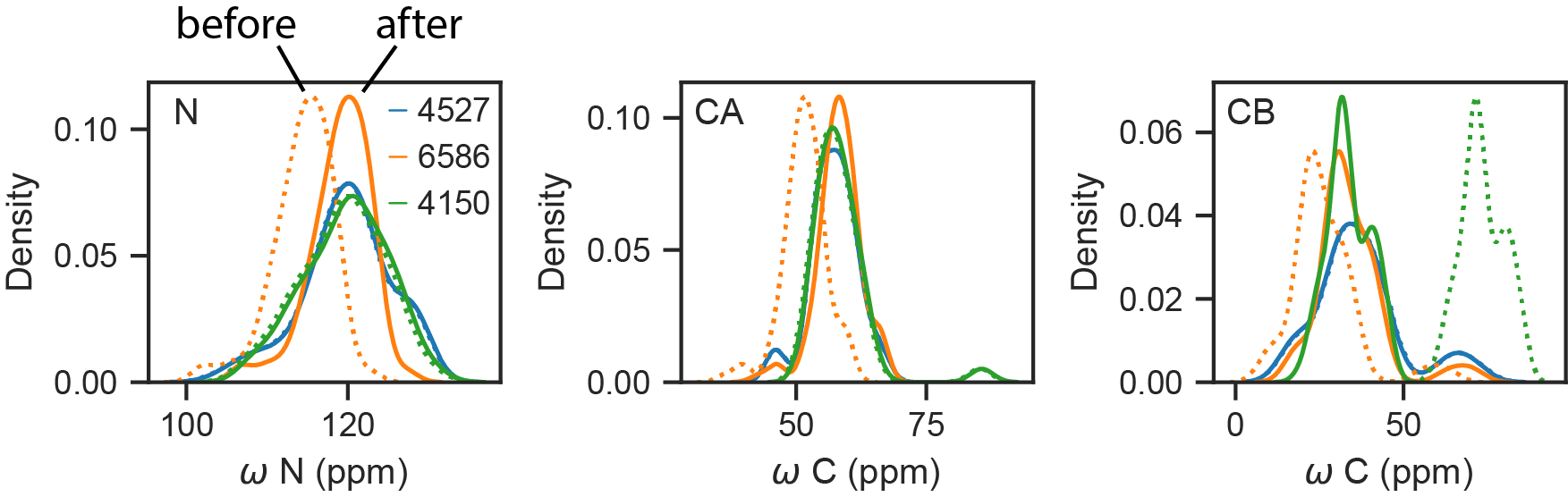
For example, entries 6586 and 4150 have been described in the literature as needing re-referencing.
Under the hood
The makeshift.reref subpackage exposes the underlying
routines if you want to work with raw DataFrames rather than a ChemicalShifts
object, you can use compute_offsets, apply_offsets, reref_lacs, and reref_panav.
Full API
See the re-referencing reference.